

Underground cable faults: Why accurate pinpointing matters
Underground electrical networks are an essential part of modern power distribution infrastructure. However, when a cable fault occurs, locating the affected point can become a challenging task for maintenance teams.
Unlike overhead lines, underground cables are not directly visible, and their routes may run beneath roads, pavements or other infrastructure. As a result, identifying where to intervene requires more than simply knowing that a fault exists.
Accurate cable tracing and fault pinpointing can make a significant difference in how maintenance operations are planned and carried out.
The challenge of locating faults in underground networks
Underground cables are exposed to different conditions throughout their service life. External damage, ageing or deterioration of the cable sheath can compromise their integrity and, in certain cases, create a path for electrical leakage to earth.
When this happens, maintenance teams need to determine not only which cable is affected, but also where the damage is located.
This can be particularly challenging in urban environments, where underground infrastructure is often complex and access to buried cables is limited.
Without reliable information about the cable route and the location of the fault, maintenance interventions may require additional investigations or excavation work.
The more accurately the affected point can be identified, the better prepared field teams can be before starting their intervention.
Cable tracing and fault pinpointing: two complementary tasks
Locating an underground cable and pinpointing a fault are not the same operation.
Cable tracing allows technicians to identify the route followed by a buried cable, providing valuable information before excavation or maintenance work.
Fault pinpointing goes one step further. In cases where damage to the cable sheath creates an electrical leakage path to earth, specialised detection techniques can help identify the location of the damaged section.
Combining both capabilities is particularly useful because it allows maintenance teams to follow the cable route while investigating the fault, rather than treating them as completely separate tasks.
This approach supports more targeted interventions and helps reduce uncertainty during field operations.


How technology supports more accurate fault location
Modern cable locating technologies provide field teams with tools to interpret signals and identify underground assets more precisely.
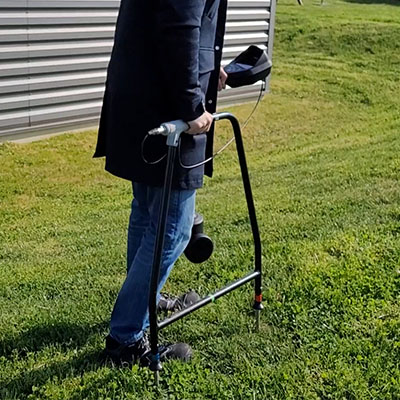
For cable sheath faults involving leakage to earth, one method uses a dedicated electrical signal and an external A-frame sensor to detect voltage differences at ground level.
By analysing these measurements along the cable route, technicians can progressively narrow down the location of the fault.
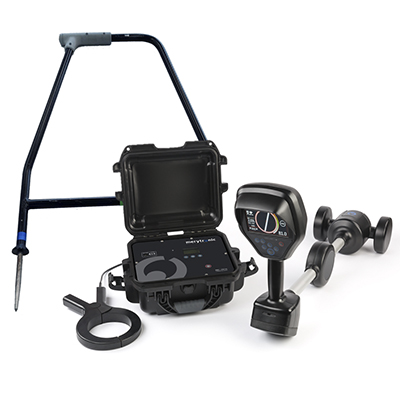
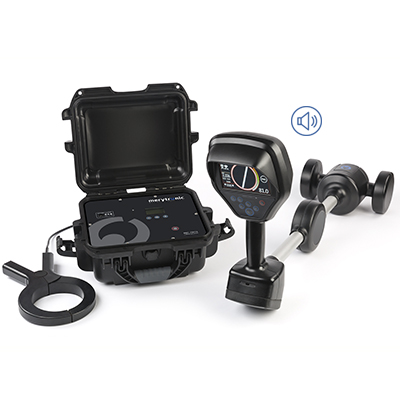
At Merytronic, we have integrated this capability into the MRT-700 FF, combining underground cable tracing and fault pinpointing in a single solution.
The system uses the MRT-700 transmitter and receiver together with an A-frame accessory. Its advanced dual display mode enables operators to follow the cable route while monitoring the information associated with fault detection.
This combination brings together two important field operations, helping maintenance professionals locate cable sheath faults and identify where intervention may be required.
See the MRT-700 FF in action
Understanding how a technology works is often easier when seeing it applied in real conditions.
In the following demonstration, the MRT-700 is used together with the A-frame accessory to identify and locate cable sheath faults.
The video illustrates how the technology supports fault location during field operations and how the different components work together.
Supporting more effective underground cable maintenance
For utilities and maintenance contractors, reliable information about underground infrastructure is essential when planning field interventions.
Technologies that combine cable route tracing with fault pinpointing provide valuable support when investigating cable sheath damage, helping teams better understand where action is needed.
At Merytronic, we develop specialised electronic solutions designed around the practical needs of electrical distribution network professionals.
Our aim is to provide technologies that help field teams work with greater precision and confidence, from locating underground assets to identifying faults.
Discover the MRT-700 FF or contact our team at info@merytronic.com to learn more about its applications.
Related News
Underground cable faults: Why accurate pinpointing matters
Underground electrical networks are an essential part of modern power distribution infrastructure. However, when a...
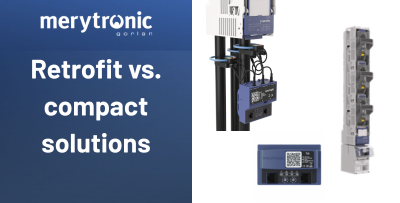
Retrofit and compact solutions: two complementary approaches to low-voltage grid digitalisation
Electrification, distributed generation and the growing adoption of electric vehicles are increasing the variability of...

From field identification to advanced supervision: Merytronic at Enlit Europe 2026
En Gorlan, hoy damos un paso decisivo hacia el futuro. Presentamos Zillion, nuestra nueva marca:...
Dowloads
Access all the information about our products.

News
Underground cable faults: Why accurate pinpointing matters
Underground electrical networks are an essential part of modern power…
Retrofit and compact solutions: two complementary approaches to low-voltage grid…
Electrification, distributed generation and the growing adoption of electric vehicles…
From field identification to advanced supervision: Merytronic at Enlit Europe…
From 10 to 12 November, we will be in Vienna…


 Gorlan
Merytronic, a  company
- Electric network digitisation | Network topology
- Smart Grids | Zillion
- Maintenance: electricity distribution networks
- Electrical Safety | Cable Identifier
- Maintenance: underground piping networks
- Piping networks digitisation for Oil&Gas
- Merytronic Training Center
- R&D projects
