


CI vs PI-3 in Cable and Phase Identification: When to use each one?
CI vs PI-3: A practical guide for Identifying Cables and Phases
In electrical distribution, cable and phase identification is a key task. Accurately determining which cable is correct and which phase it belongs to is critical for safety, service continuity, and project timelines.
At Merytronic, these tasks are solved with two complementary solutions: Ariadna CI (positive cable identification, energized or de-energized) and PI-3 (phase and cable identification when de-energized, optimized for cuts and splices).
When to use Ariadna CI?
- Network energized or de-energized to confirm the cable before digging or cutting.
- Typical work points: trenches, manholes, and secondary substation entries/exits.
- Active signal via induction clamp or direct connection and polarity check (positive identification).
- Extended range from the injection point (in direct mode), useful for confirming sections without opening multiple manholes.
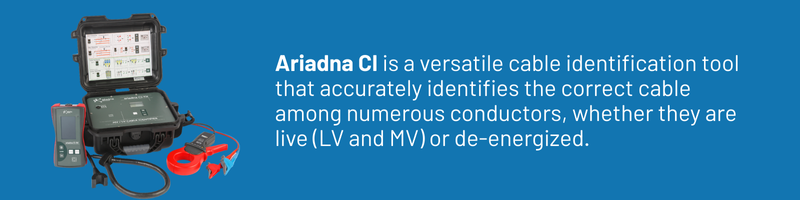
How It Works:
Ariadna CI is the “all-terrain” solution for unequivocally identifying the correct cable among several conductors, both energized (LV and MV) and de-energized.
It injects an active signal, either by direct connection or induction clamp, and the receiver detects amplitude and polarity to confirm the correct cable. It is certified by utilities worldwide for electrical safety procedures and offers great transmitter autonomy, with ranges up to 50 km via direct connection.
In energized LV and MV networks, the transmitter acts as a load that “modulates” the network current, allowing cable identification in trenches, manholes, or substation entries/exits without de-energizing. In de-energized cables, the signal energy comes from its Li-ion battery, and can be injected via direct connection or induction clamp.
When to use PI-3?
- De-energized operation (discharge completed) when cutting/splicing is required.
- You need to match phases between two ends (splices, extensions, branches, overhead-to-underground conversions).
- You want to reduce time and errors when identifying R-S-T on multiple conductors at once (three simultaneous clamps; option for two transmitters in parallel to work at origin and destination).
How It Works:
PI-3 is designed for splicing, switching, and phase-to-phase connections when the line is de-energized. With a single device, you can identify any de-energized cable (single or three-phase) and correctly assign its phases. The key operational difference is that the transmitter includes three inductive clamps (and also supports direct connection), injecting simultaneous signals into all three phases, while the receiver reads each phase without changing connections.
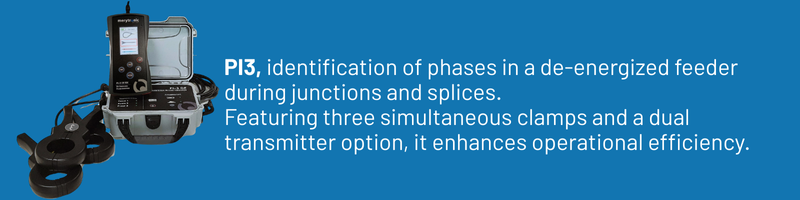
Why PI-3 spededs up splice identification
- Three clamps = three simultaneous phases. The transmitter injects polarized currents into R, S, and T at the same time; the receiver shows amplitude and polarity per phase, so no need to move clamps or reconfigure the TX.
- Dual transmitter = two active “windows.” With TR-A at the origin substation and TR-B at the destination, both injecting simultaneously, you can read all six ends at the splice point without waiting. This shifts from serial (before) to parallel (now), directly reducing steps and time.
- Switch to direct if you need “more signal.” On long sections or shielded cables, if induction reading is weak, the protocol allows switching to direct connection (under safety standards) for a strong, stable signal.
Two reasons: Operational safety and identification quality in cable and phase identification
- Ariadna CI on energized network. The transmitter acts as a controlled load; the receiver validates by amplitude and polarity. Result: positive identification without de-energizing, minimizing risk of incorrect cuts and service impact.
- PI-3 on de-energized lines. Phases are verified before closing the splice, reducing operational risks. The device is designed for fast, repeatable use without complex field adjustments.
Practical Tip: If “WEAK SIGNAL” appears with loop sensor, switch to direct connection and repeat the measurement: SNR improvement is usually immediate.
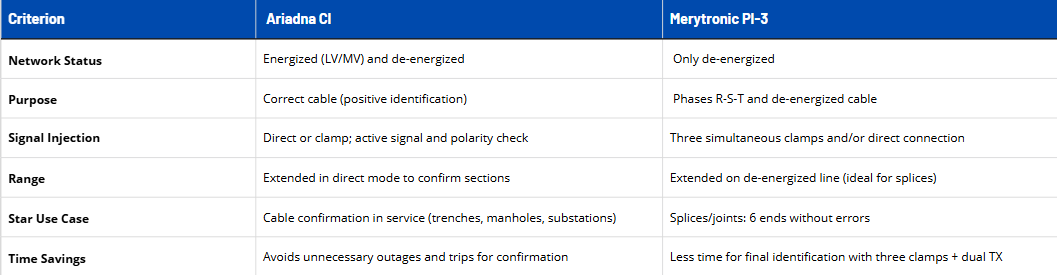
Quick comparison (CI vs PI-3)
Real cases and best practices in cable and phase identification
- Splice between substations (urban project). Discharge, verify absence of voltage and CC-PT. Install TR-A at origin and TR-B at destination. At the splice point, identify all six ends with PI-3 and close phase-to-phase. If induction is low, switch to direct at the nearest substation.
- Confirm cable before opening trench (energized). Connect CI-Tx at an accessible point (phase-neutral or phase-phase) and verify in the manhole with CI-Rx. Avoid unnecessary cuts and work under safety procedures.
- MV extension de-energized. Use PI-3 to assign R-S-T to a new branch without moving clamps; plan direct connection if the section is long.
Related News
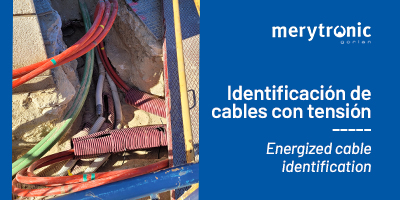
Advantages of identifying live LV and MV electrical cables
Identification of live electrical cables, a need The repair of breakdowns and maintenance works on...
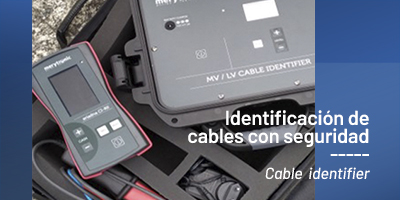
How to identify an energized cable safely?
Identify any type of cable with Ariadna CI In maintenance tasks, correctly identifying cables in...
Dowloads
Access all the information about our products.

News
Merytronic in New Zeland – EEA Conference 2026
Merytronic strengthens its technical presence in New Zealand at EEA…
Sustainability Report 2025
Our 2025 Sustainability Report presents the most significant achievements, initiatives…




 Gorlan
Merytronic, a  company
- Electric network digitisation | Network topology
- Smart Grids | Zillion
- Maintenance: electricity distribution networks
- Electrical Safety | Cable Identifier
- Maintenance: underground piping networks
- Piping networks digitisation for Oil&Gas
- Merytronic Training Center
- R&D projects